
Unlocking Potential Together: Speech and Occupational Therapy Transform Lives
Global Developmental Delay (GDD) is the usual diagnosis when a child is observed to be falling behind in multiple developmental areas. This may include the cognitive, motor, social, and language sectors. Although developmental delay in children, Durham, can feel overwhelming for families, in this day and age, there is now an immense hope in a collaborative approach. The most powerful team for a child with GDD is often a combination of Speech-Language Pathology (SLP) and Occupational Therapy (OT).
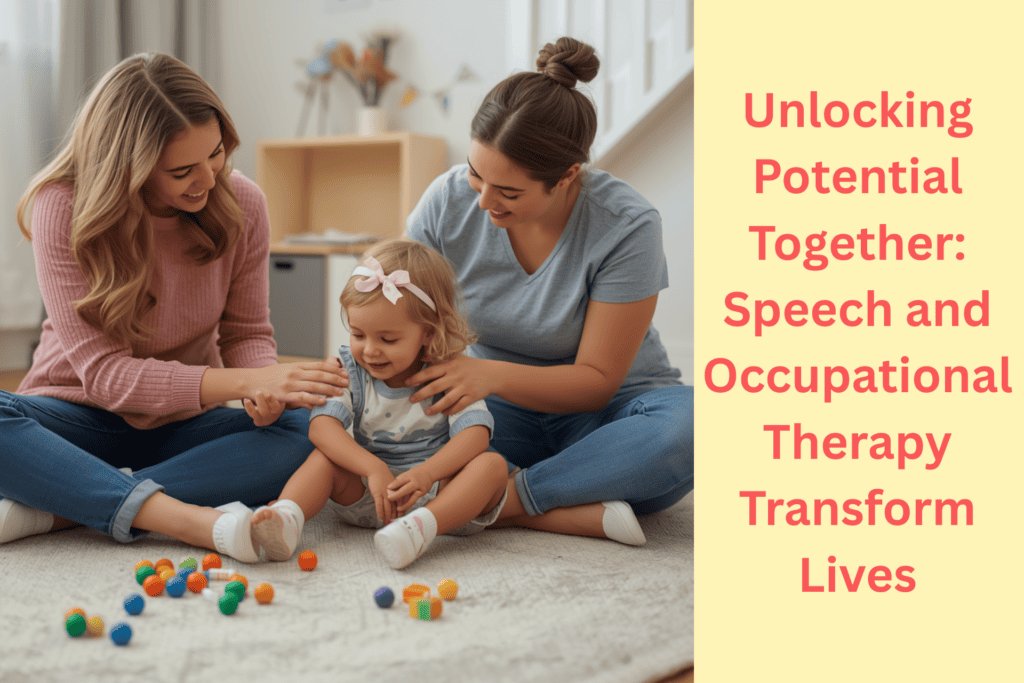
Despite being two distinct disciplines, when speech therapy and occupational therapy work together, this synergy accelerates developmental gains. This is because having this approach addresses the needs of the “whole child.” This is instead of separate and isolated symptoms in developmental delay in children, Durham.
Building a Strong Foundation for Those with Developmental Delay in Children, Durham
In this multi-disciplinary approach, Occupational Therapists (OTs) focus on the sensory, motor, and cognitive skills needed for daily life. This includes activities such as holding a spoon, dressing, or processing sensory input. Speech Therapists (SLPs), on the other hand, focus on communication. This means for assistance in understanding language, using words, or utilizing AAC devices for those with developmental delay in children, Durham.
In a child with GDD, these two disciplines need to be intertwined to achieve the best outcome. For example, a child with sensory processing challenges is perhaps overwhelmed by noise or movement. At the same time, the child also struggles to focus on learning new words. In this case, an OT can help regulate that child’s nervous system through sensory integration activities, such as swinging or deep pressure techniques. Once regulated and calm, that child is more capable of engaging with an SLP to build language skills.
The Power of Co-Treatment to Address Developmental Delay in Children, Durham
This “co-treatment,” where both therapists work with the child simultaneously is often the best approach when it comes to global developmental delay in children, Durham. This is because having both offers a holistic approach to therapy, thereby allowing therapists to work on multiple goals in one session. Not only that, this integrated approach makes learning natural and functional. As a result, this makes it more efficient and engaging for the child. Imagine a scenario wherein the team creates an obstacle course for a child. While the OT assists the child with balance, coordination, and motor planning, the SLP, on the other hand, is guiding the child to follow multi-step directions. This includes naming objects and practicing communication skills like “go” or “stop.”
Key Areas of Collaboration
Sensory Regulation & Expression
We know that when a child can’t communicate their needs, they become frustrated and throw a tantrum. In this case, OTs help children identify sensory needs, while SLPs guide them through the use of words or visuals to ask for help.
Feeding and Oral Motor Skills
OT/SLP collaboration is vital for feeding therapy. This is because SLP works on safe swallowing and oral motor strengthening. On the other hand, the OT supports posture, stability, and sensory tolerance for different food textures.
Social Skills and Play
Having joint sessions is a perfect way to practice turn-taking, sharing, and interpreting non-verbal social cues through play-based activities.
A Brighter Future Through Teamwork
When speech and occupational therapists join together, this creates a cohesive plan that addresses the interconnected and overlapping nature of developmental delays. Because of this, the goal is to provide a comprehensive support system that reduces parental stress and boosts the child’s confidence, independence, and overall functional skills. So, if you observe your child to be lagging behind, it is best to get them assessed with us, here at Speech Link, as soon as possible.